
Is Earwax Buildup Affecting Your Hearing? Signs It May Be Time for Professional Removal
A blocked or muffled ear may be caused by something as simple as earwax buildup. Learn the common signs, what not to do at home, and when to have your ears professionally checked in Oakville.
Does one ear suddenly feel plugged? Are conversations sounding muffled, or has your hearing aid stopped sounding as clear as it normally does?
Earwax buildup may be the reason.
At Clarity Hearing Clinic of Oakville, we regularly meet people who are concerned that their hearing has suddenly worsened, only to discover that earwax is partially or completely blocking the ear canal. Although earwax is normal and helpful, too much of it can sometimes interfere with hearing and cause uncomfortable symptoms.
Here is how to recognize the signs of earwax buildup, what you should avoid doing at home and when it may be time to have your ears professionally checked.
What Is Earwax—and Why Do We Have It?
Earwax, medically known as cerumen, is produced naturally inside the ear canal. Despite its reputation, earwax is not dirty or unhealthy. It helps protect the ear by trapping dust and debris, moisturizing the delicate skin of the ear canal and helping keep unwanted material away from the eardrum.
Most ears are self-cleaning. Everyday jaw movements, such as chewing and talking, help gradually move old wax toward the opening of the ear, where it can dry and fall away naturally.
Problems can arise when the ear produces more wax than it can remove or when the wax becomes pushed deeper into the canal.
What Are the Signs of Earwax Buildup?
Earwax buildup does not feel exactly the same for everyone. Common signs may include:
• Muffled or reduced hearing
• A plugged, blocked or full sensation in the ear
• Ringing or buzzing in the ear, known as tinnitus
• Itching inside the ear canal
• Mild discomfort
• Hearing aids that seem weak, distorted or inconsistent
• Feedback or whistling from a hearing aid
• A visible buildup of wax near the opening of the ear
Symptoms may affect one or both ears and can develop gradually. Because earwax blockage and hearing loss can feel similar, an examination of the ear is the best way to determine whether wax is actually responsible.
Can Earwax Cause Hearing Loss?
Yes. When enough wax collects in the ear canal, it can prevent sound from travelling efficiently toward the eardrum. This may cause a temporary type of hearing loss called conductive hearing loss.
When wax is the cause, hearing will often improve after the blockage has been safely removed. However, not every change in hearing is caused by earwax.
If your ear canal is clear but you are still noticing difficulty hearing, a comprehensive hearing assessment can help determine whether an underlying hearing loss is present.
A sudden or significant change in hearing—particularly in one ear—should always be assessed promptly rather than assumed to be wax.
Why Do Some People Develop More Earwax Than Others?
Some people naturally produce more earwax. Others have ear canals that are narrow, curved or more difficult for wax to exit.
Earwax buildup may also be more common among:
• People who wear hearing aids, earbuds or earplugs regularly
• Older adults, as earwax may become drier and harder with age
• People with narrow or unusually shaped ear canals
• Individuals who frequently use cotton swabs
• People who have previously experienced recurring wax blockages
Hearing aids can contribute to buildup because they sit inside or near the ear canal. Earwax can also block hearing aid receivers and microphones, affecting how the devices perform. Regular ear and hearing aid checks can help prevent these problems.
Should You Use Cotton Swabs to Clean Your Ears?
It is best not to place cotton swabs—or anything else—inside your ear canal.
Although a cotton swab may remove a small amount of wax near the entrance, it can also push the remaining wax farther into the ear. This may pack the wax more tightly, irritate the ear canal or injure the eardrum.
As audiologists sometimes say: do not put anything smaller than your elbow in your ear.
You can gently clean the visible outer portion of the ear with a soft cloth, but the inside of the ear canal generally does not need routine cleaning.
Ear candles are also not recommended. They have not been shown to remove earwax effectively and can cause burns, blockage or injury.
Can You Remove Earwax at Home?
Some people may be able to use wax-softening drops, but home treatment is not appropriate for every ear.
Before putting drops or water into your ear, speak with a qualified healthcare professional if you have:
• Ear pain, bleeding or drainage
• A known or suspected perforated eardrum
• Ear tubes
• Previous ear surgery
• Recurring ear infections
• Significant dizziness
• Diabetes or a compromised immune system
• A foreign object in the ear
• Uncertainty about what is causing your symptoms
If you experience pain, drainage or bleeding, seek medical advice rather than assuming the problem is earwax.
What Happens During a Professional Earwax Removal Appointment?
At Clarity Hearing Clinic of Oakville, we begin by asking about your symptoms and relevant ear-health history. We then carefully examine your ear canals and eardrums.
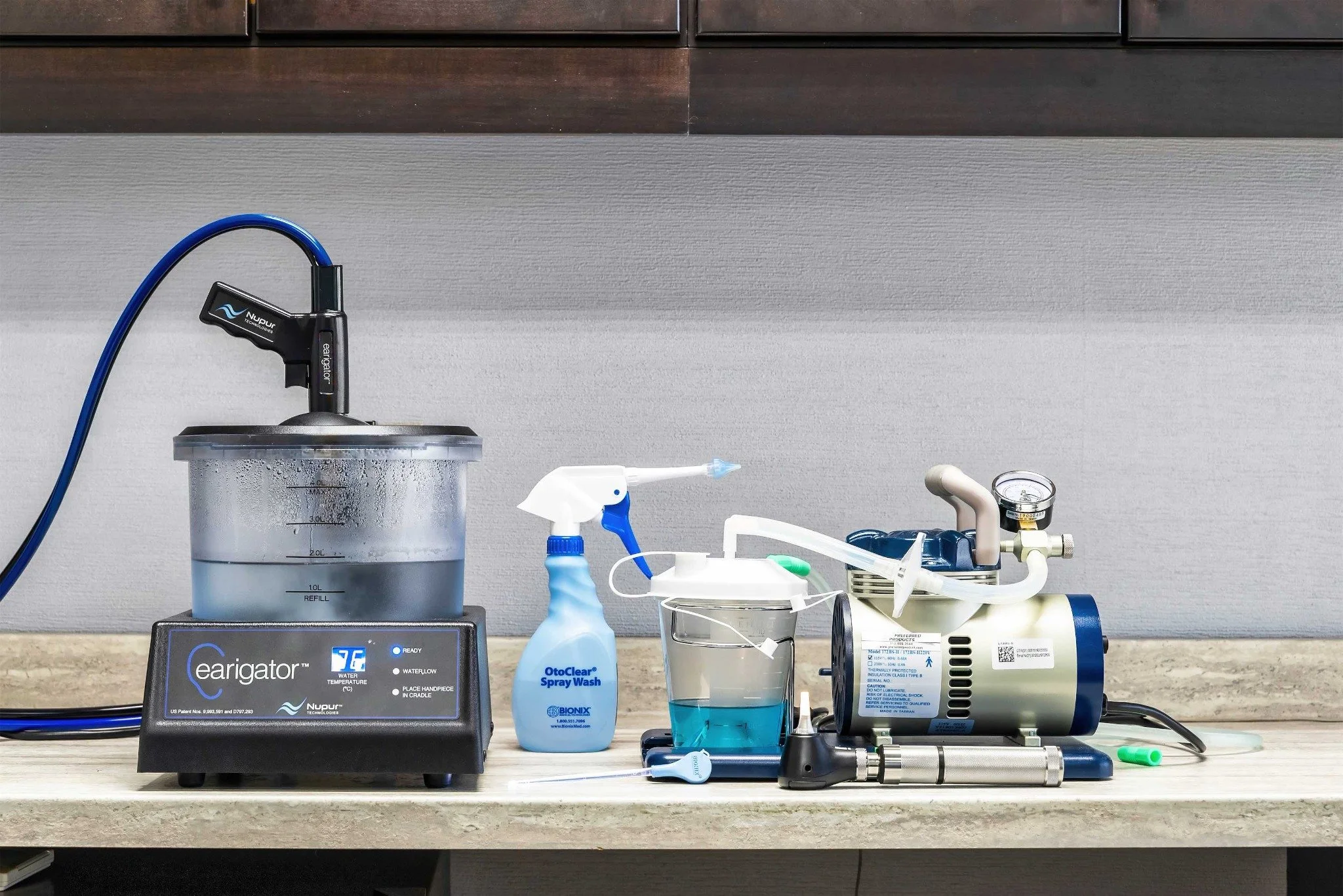
If wax is present, we determine which removal approach is most appropriate for your ears and the type of wax involved. Depending on your needs, professional removal may involve irrigation, suction or specialized instruments.
Some wax is soft and relatively easy to remove. Hard, dry or deeply impacted wax may require softening drops before it can be removed comfortably. Occasionally, a follow-up visit is recommended rather than trying to remove stubborn wax all at once.
After removal, we examine the ear again. If your hearing continues to feel reduced once the ear canal is clear, we may recommend a hearing test to investigate further.
Does Professional Earwax Removal Hurt?
Earwax removal should generally not be painful, although you may notice pressure, movement, water or sound during the procedure.
If the ear canal is irritated or the wax is very dry and firmly lodged, the ear may be more sensitive. Please let us know immediately if you feel discomfort. We can pause, change our approach or recommend additional softening before continuing.
When Should You Book an Earwax Check?
Consider having your ears examined if:
• Your hearing has become muffled or reduced
• One or both ears feel plugged
• Your hearing aids are whistling or not performing normally
• You have a history of recurring earwax buildup
• You can see wax but cannot remove it safely
• You are unsure whether your symptoms are caused by wax or hearing loss
You do not need to know for certain that wax is present before booking an appointment. Looking inside the ear is the first step.
Earwax Removal in Oakville
If your ears feel blocked or your hearing has changed, Clarity Hearing Clinic of Oakville can examine your ears and help determine the cause.
As a locally owned and independent hearing clinic, we believe in making ear and hearing care comfortable, straightforward and personal. We will explain what we see, discuss the appropriate options and never make you feel rushed.
Contact Clarity Hearing Clinic of Oakville to schedule an ear examination or professional earwax removal appointment.
What to Expect During a Hearing Test in Oakville
Thinking about booking a hearing test? Learn exactly what to expect during a hearing assessment at Clarity Hearing Clinic of Oakville, from your initial conversation to your personalized results.
What to Expect During a Hearing Test at Clarity Hearing Clinic of Oakville
Many people hesitate to have their hearing tested.
As an audiologist, I have always found this interesting. People routinely have their eyes checked, complete blood work and attend regular physicals, but hearing health often gets placed on the back burner.
Why?
Some people worry that a hearing test will take a lot of time. Others may be nervous about finding out that they have hearing loss or worry that they will automatically be told they need hearing aids. There is also still some stigma surrounding hearing aids, along with the concern that visiting a hearing clinic may lead to a high-pressure sales conversation.
These are all understandable concerns. They are also exactly why I wanted to explain what you can expect when you book a hearing test at Clarity Hearing Clinic of Oakville.
Our goal is to help you understand your hearing clearly, answer your questions and provide recommendations based on your individual needs—without pressure.
What Happens During a Hearing Test?
A hearing test, also called a hearing assessment, is a comfortable and straightforward process. It allows us to measure how well you hear different sounds and understand speech.
Here is what you can expect during your appointment at our Oakville hearing clinic.
Step 1: Completing Your Hearing History
When you arrive at Clarity Hearing Clinic of Oakville, you will be welcomed by our receptionist. She will collect some general information and provide you with a hearing health history form.
This form helps your clinician understand your hearing concerns, medical history and goals before beginning the assessment.
You may be asked questions such as:
Do you notice difficulty hearing during everyday conversations?
Are there particular situations in which hearing is more challenging?
Do people sometimes seem as though they are mumbling?
Have you had your hearing tested before?
Is there a family history of hearing loss?
Have you experienced ringing in your ears, dizziness, ear pain or pressure?
Have you been exposed to loud noise at work or during recreational activities?
There are no right or wrong answers. This information simply helps us personalize your appointment.
Step 2: Discussing Your Concerns and Goals
Once your form is complete, one of our clinicians will bring you into a private consultation room. We will discuss your concerns in more detail and find out what you hope to learn from the appointment.
Your goal may simply be to establish a baseline and monitor your hearing over time. You may be attending because your spouse or family members have noticed a change. You may already suspect hearing loss and want to understand whether hearing aids or another solution could help.
Whatever brings you in, we will tailor the appointment to your concerns and comfort level.
Having your hearing tested does not mean that you are committing to hearing aids. The first step is simply gathering accurate information about your hearing.
Step 3: Checking Your Ears
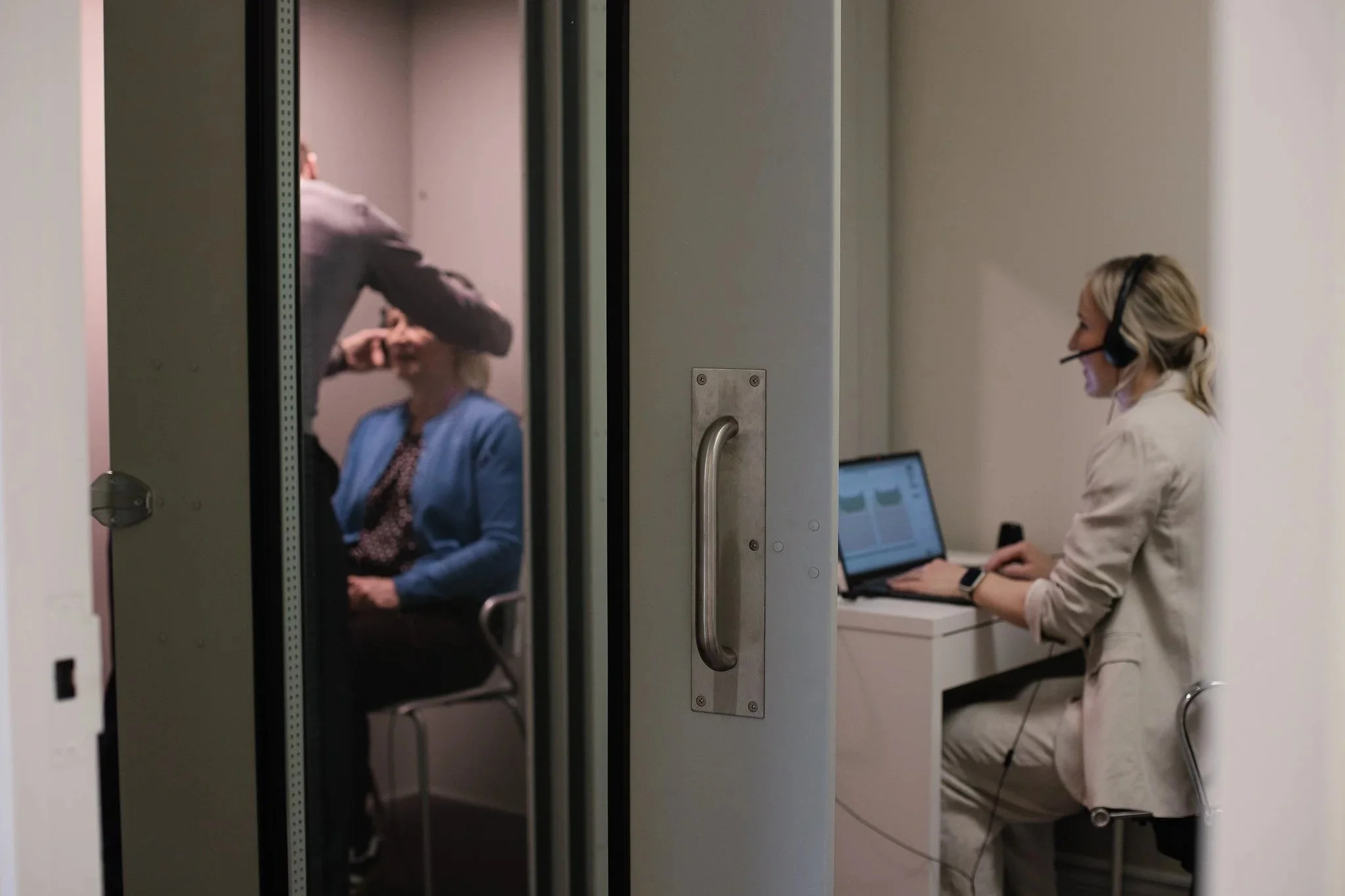
The hearing test takes place in a sound-treated booth. This is a very quiet room designed to prevent outside noise from affecting your results.
Before beginning, your clinician will look inside your ears using an otoscope. This allows us to check for earwax, irritation or anything else that could affect your hearing or the accuracy of the test.
If your ear canals are clear, we can proceed with the hearing assessment.
Step 4: Listening for Different Sounds
During the first part of the hearing test, you will listen to a series of beeps or tones through headphones or small earphones.
The sounds will begin at a comfortable level and gradually become softer. You will be asked to respond whenever you hear a sound, even when it is very faint.
We test a range of pitches because hearing loss does not always affect every frequency equally. Some people may hear lower-pitched sounds well but have more difficulty hearing higher-pitched sounds, including parts of speech.
This portion of the assessment helps us determine the softest sounds you can hear at different pitches.
Step 5: Speech Testing
We will also complete speech testing.
This part of the assessment helps us understand:
The softest level at which you can detect speech
How clearly you can understand words when they are loud enough to hear comfortably
Whether certain speech sounds are more difficult for you to process
Speech testing is especially important because many people do not describe their concern as “not hearing.” Instead, they may say that people mumble, conversations are unclear or they can hear someone speaking but cannot understand every word.
Step 6: Reviewing Your Hearing Test Results
After the hearing test, your clinician will review your results with you in clear, easy-to-understand language.
We will explain:
Whether your hearing is within the normal range
Whether hearing loss is present
The degree of hearing loss, such as mild, moderate, severe or profound
The type and pattern of hearing loss
How the results may be affecting your ability to understand speech
Whether monitoring, medical follow-up or hearing technology should be considered
A hearing test can help identify the type and pattern of hearing loss. In some cases, additional medical assessment may be required to better understand the underlying cause.
If hearing loss is present, we will explain why certain voices, words or situations may be more difficult. For example, you may hear that someone is speaking but miss softer consonant sounds, making speech seem unclear or as though everyone is mumbling.
Most importantly, you will have an opportunity to ask questions and discuss your options.
What Happens If I Have Hearing Loss?
Not every person with hearing loss requires the same solution.
Depending on your results, lifestyle and concerns, recommendations may include:
Monitoring your hearing over time
Protecting your hearing from loud noise
Having earwax removed
Seeking additional medical assessment
Using communication strategies
Exploring hearing aids or other hearing technology
Our recommendations are based on your hearing, your daily life and your goals. You will never be pressured into making a decision during your appointment.
When Should You Book a Hearing Test?
Consider booking a hearing test if:
You frequently ask people to repeat themselves
Family members have expressed concerns about your hearing
You turn the television or radio louder than others prefer
Conversations are difficult in restaurants or group settings
People often seem to mumble
You experience ringing or buzzing in your ears
You have a history of noise exposure
You have never had a baseline hearing test
Even if you are not experiencing noticeable difficulty, a baseline hearing assessment gives us something to compare with future results.
Book a Hearing Test in Oakville
A hearing test is simply an opportunity to learn more about your hearing health. It is comfortable, informative and does not come with any obligation to purchase hearing aids.
At Clarity Hearing Clinic of Oakville, we take the time to listen to your concerns, explain your results and help you understand your options.
If you have been putting off your hearing test, we would be happy to welcome you to our independent Oakville hearing clinic.
Contact Clarity Hearing Clinic of Oakville to schedule your hearing assessment.